CHAPTER 3

Lesson 31 · Questions

Asking questions

Questions are the start of language learning

Asking questions is very important when learning a new language. It helps you think about how to make sentences and use the right words. When you ask questions, you learn more because you get answers that give you new information.

Questions also make you talk to other people, which is a great way to practice the language. Talking and listening help you understand how the language works in real conversations.

When you ask questions, you can find out things you don’t know and clear up any confusion. This makes you feel more confident using the language.

In short, asking questions helps you learn faster, practice more, and understand the language better. It’s a simple but powerful way to improve your language skills.

Wat

What

Wat is je naam?

What is your name?

Wat is dit?

What is this?

Explanation: Use "what" to ask about things or actions. For example, "What is that noise?" or "What do you like to eat?"

Waar

Where

Waar woon je?

Where do you live?

Waar is de winkel?

Where is the store?

Explanation: Use "where" to ask about places or locations. For example, "Where are you going?" or "Where did you find this?"

Wanneer

When

Wanneer ben je jarig?

When is your birthday?

Wanneer zal het gebeuren?

When will it happen?

Explanation: Use "when" to ask about time. For example, "When will you arrive?" or "When is the meeting?"

Waarom

Why

Waarom ben je nog thuis?

Why are you still at home?

Waarom is de lucht blauw?

Why is the sky blue?

Explanation: Use "why" to ask about reasons. For example, "Why did you leave early?" or "Why are you crying?"

Wie

Who

Wie is jouw leraar?

Who is your teacher?

Wie is Anna?

Who is Anna?

Explanation: Use "who" to ask about people. For example, "Who called you?" or "Who is your friend?"

Hoe

How

Hoe gaat het met je?

How are you? (notice it concerns the well known greeting as discussed in lesson 1)

Hoe maak je dit?

How do you make this?

Explanation: Use "how" to ask about ways or methods. For example, "How did you do that?" or "How is the weather?"

Welk / welke

Which

Welk boek is van jou?

Examples :1. Which book is yours?

Welke richting zullen we nemen?

Which direction should we take?


Explanation: Use "which" to ask about choices. For example, "Which color do you like?" or "Which one is better?".

Notice that in Dutch we have "welke" and "welk". The word "welk" is used with a "het"- word and "welke" with a "de"-word.


Question words

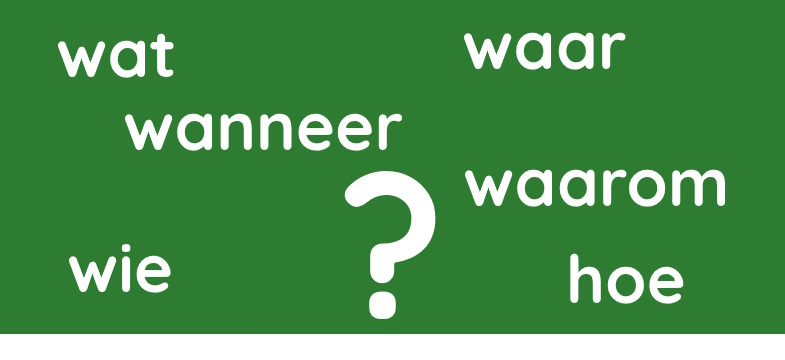
Dutch question words

Listening practice

Listen & practise

Question words

← Back to overview

Read the Dutch sentence and its meaning. Listen, then say it aloud.

01
Wat.What.
02
Waar.Where.
03
Wanneer.When.
04
Waarom.Why.
05
Wie.Who.
06
Hoe.How.

What-questions

What-questions are the most common type of questions. With these questions, you seek to know more: what is that?

Listen & practise

What · 1

← Back to overview

Read the Dutch sentence and its meaning. Listen, then say it aloud.

01
Wat is dat?What is that?
02
Dat is een pen.That is a pen.
03
Wat hoor je?What do you hear?
04
Ik hoor een vogel.I hear a bird.
05
Wat zie je?What do you see?
06
Ik zie een paard.I see a horse.
Listen & practise

What · 2

← Back to overview

Read the Dutch sentence and its meaning. Listen, then say it aloud.

01
Wat wil je?What do you want?
02
Ik wil naar de stad.I want to go to the city.
03
Wat is daar?What is there?
04
Daar is een feest.There is a party.
05
Wat vind je ervan?What do you think of it?
06
Ik vind het niet goed.I don't think it's good.

Where-questions

Where-questions refer to a place. With these questions, you seek to know more about a place: where is it?

Listen & practise

Where · 1

← Back to overview

Read the Dutch sentence and its meaning. Listen, then say it aloud.

01
Waar is Anna?Where is Anna?
02
Anna is in de stad.Anna is in the city.
03
Waar is Jan?Where is Jan?
04
Jan rijdt in de auto.Jan is driving the car.
05
Waar is Vicky?Where is Vicky?
06
Vicky is in de kamer.Vicky is in the room.
Listen & practise

Where · 2

← Back to overview

Read the Dutch sentence and its meaning. Listen, then say it aloud.

01
Waar is de kaas?Where is the cheese?
02
De kaas ligt in de ijskast.The cheese is in the fridge.
03
Waar is mijn pen?Where is my pen?
04
De pen ligt op de tafel.The pen is on the table.
05
Waar is Tim?Where is Tim?
06
Tim speelt buiten.Tim is playing outside.

When-questions

When-questions refer to a time. With these questions, you seek to know more about a time: when do you come?

Listen & practise

When · 1

← Back to overview

Read the Dutch sentence and its meaning. Listen, then say it aloud.

01
Wanneer kom je?When are you coming?
02
Ik kom maandag.I'm coming on Monday.
03
Wanneer ga je?When are you leaving?
04
Ik ga vrijdag.I'm leaving on Friday.
05
Wanneer ben je er?When will you be there?
06
Ik ben er om 9 uur.I will be there at 9 o'clock.
Listen & practise

When · 2

← Back to overview

Read the Dutch sentence and its meaning. Listen, then say it aloud.

01
Wanneer komt de bus?When is the bus coming?
02
De bus komt om 10 uur.The bus is coming at 10 o'clock.
03
Wanneer gaat de trein?When is the train leaving?
04
De trein gaat om 11 uur.The train leaves at 11 o'clock.
05
Wanneer gaat het gebeuren?When is it going to happen?
06
Morgen.Tomorrow.

Why-questions

Why-questions refer to a cause. With these questions, you seek to find a reason : Why did it happen?

Listen & practise

Why · 1

← Back to overview

Read the Dutch sentence and its meaning. Listen, then say it aloud.

01
Waarom betaal je niet?Why aren't you paying?
02
Ik heb nu geen geld.I don't have money right now.
03
Waarom drink je niet?Why aren't you drinking?
04
Ik heb geen dorst.I'm not thirsty.
05
Waarom eet je niet?Why aren't you eating?
06
Ik heb geen honger.I'm not hungry.
Listen & practise

Why · 2

← Back to overview

Read the Dutch sentence and its meaning. Listen, then say it aloud.

01
Waarom heb je dat gedaan?Why did you do that?
02
Ik weet het niet.I don't know.
03
Waarom doe je het niet?Why aren't you doing it?
04
Ik kan het niet.I can't do it.
05
Waarom kom je niet?Why aren't you coming?
06
Ik ben verhinderd.I'm prevented from coming.

Who-questions

Who-questions refer to a person. With these questions, you seek to a certain person or group: who did it?

Listen & practise

Who · 1

← Back to overview

Read the Dutch sentence and its meaning. Listen, then say it aloud.

01
Wie komt morgen?Who is coming tomorrow?
02
Jan komt morgen.Jan is coming tomorrow.
03
Wie doet het?Who is doing it?
04
Tim doet het.Tim is doing it.
05
Wie heeft de beurt?Who has the turn?
06
Anna heeft de beurt.Anna has the turn.
Listen & practise

Who · 2

← Back to overview

Read the Dutch sentence and its meaning. Listen, then say it aloud.

01
Wie is gekomen?Who came?
02
Jan is gekomen.Jan came.
03
Wie heeft het gedaan?Who did it?
04
Tim heeft het gedaan.Tim did it.
05
Wie is er?Who is there?
06
Anna is er.Anna is there.

How-questions

How-questions ask about the way something happens: How did it happen?

Listen & practise

How · 1

← Back to overview

Read the Dutch sentence and its meaning. Listen, then say it aloud.

01
Hoe kan dat?How is that possible?
02
Dat weet ik niet.I don't know.
03
Hoe maak je dat?How do you make that?
04
Dat moet je zo doen.This is how you should do it.
05
Hoe moet dat?How should it be done?
06
Kijk naar de illustratie.Look at the illustration.
Listen & practise

How · 2

← Back to overview

Read the Dutch sentence and its meaning. Listen, then say it aloud.

01
Hoe is het?How is it?
02
Het is goed.It is good.
03
Hoe voel je je?How do you feel?
04
Ik voel me goed.I feel good.
05
Hoe kom je in Amsterdam?How do you get to Amsterdam?
06
Met de trein.By train.

Dutch question patterns

Wat is je naam? and Hoe heet je? both ask someone’s name. Do not translate each English word separately.

In Waar woon je?, the verb comes before the subject. But if the question word is itself the subject, it directly takes the verb: Wie komt morgen?

Welk goes with a singular het noun: Welk boek? Use welke with a singular de noun or a plural: Welke jas?, Welke boeken?